Quick Answer
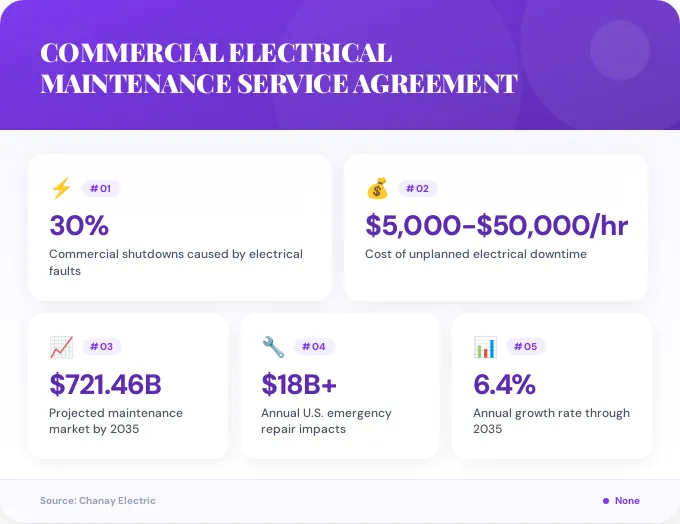
A commercial electrical maintenance service agreement is a recurring contract with a licensed contractor that schedules inspections, preventive maintenance, and emergency response for a building’s electrical systems. It protects against costly unplanned downtime, which can run $5,000 to $50,000 per hour depending on the facility, and creates a documented safety and compliance record that insurers, inspectors, and tenants increasingly expect.
A breaker panel that trips twice in one week rarely gets attention until the third time it happens during a Monday morning rush. By then, the real question is not whether the building has an electrical problem, it is how long it has been building and who was supposed to catch it. That gap, between a problem forming and a problem being found, is exactly what a commercial electrical maintenance service agreement is designed to close.
Electrical faults are reportedly responsible for close to 30% of commercial-building shutdowns, with annual U.S. impacts from emergency repairs, lost productivity, and liability exposure estimated to exceed $18 billion according to industry tracking cited by commercial electrical services research. For a property owner or facility manager, that statistic is not abstract. It is the reason forward-looking buildings are shifting from reactive repairs to structured, scheduled maintenance relationships with a licensed electrical contractor.
What Is a Commercial Electrical Maintenance Service Agreement?
A commercial electrical maintenance service agreement is a recurring contract between a property owner or facility operator and a licensed electrical contractor. It spells out scheduled inspections, preventive maintenance tasks, emergency response commitments, documentation standards, pricing, exclusions, and performance expectations for the building’s electrical assets, from main switchgear down to individual panels and receptacles.
Unlike a one-off repair call, the agreement establishes an ongoing relationship. The contractor becomes familiar with the building’s specific panels, load history, and problem areas over time, which allows issues to be caught earlier and addressed with far less disruption than an emergency visit.
Why Does Preventive Electrical Maintenance Matter So Much Right Now?
The commercial property maintenance market is projected to reach $412.8 billion in 2026 and grow to roughly $721.46 billion by 2035, a pace of approximately 6.4% annually, according to market analysis from commercial property maintenance services market research. That growth reflects a shift in how building owners think about electrical systems: not as fixed infrastructure that only needs attention when it breaks, but as an asset that requires active management.
Unplanned electrical downtime is one of the clearest financial arguments for that shift. Depending on occupancy type and the systems affected, the cost of an outage can range from $5,000 to $50,000 per hour. A single afternoon without power in a restaurant, medical office, or data-dependent business can erase weeks of margin, and that is before accounting for spoiled inventory, missed appointments, or reputational damage with tenants and customers.
What Should Be Included in a Strong Service Agreement?
Not all service agreements are built the same way, and the difference often shows up in an emergency. A well-structured agreement should spell out exactly what is covered, how often, and what happens when something unexpected is found.
- Scheduled inspection frequency. Most commercial programs include one to four visits annually, depending on equipment criticality and building type.
- Thermal imaging and load testing. Infrared scans catch loose connections and overheating components before they fail.
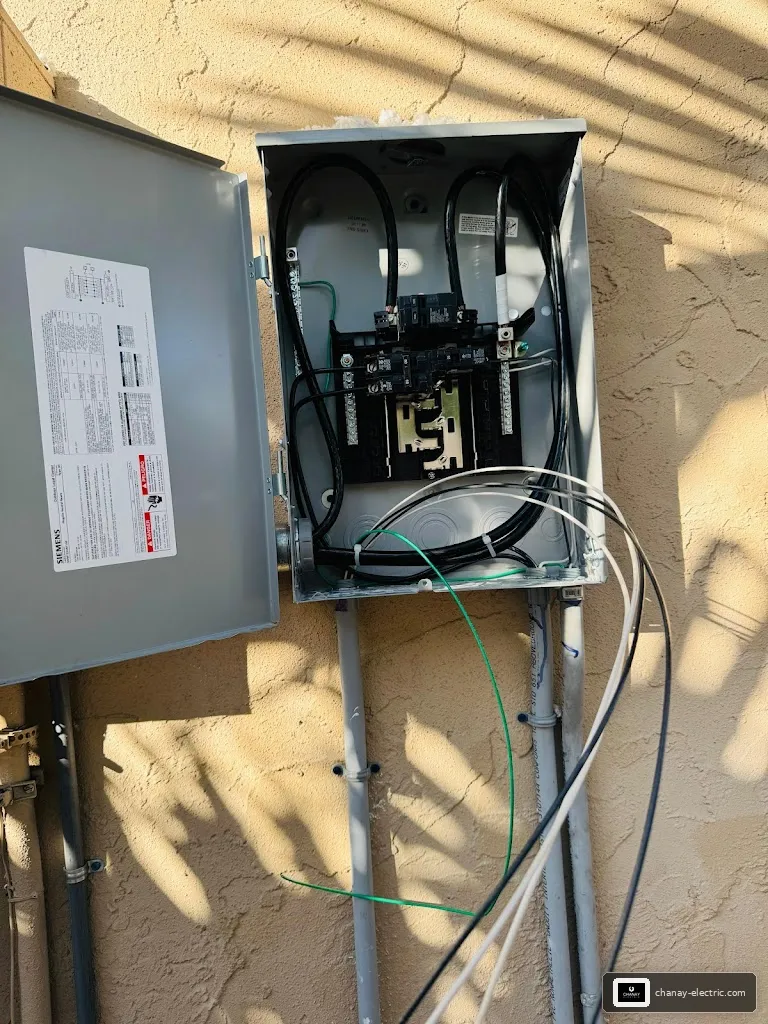
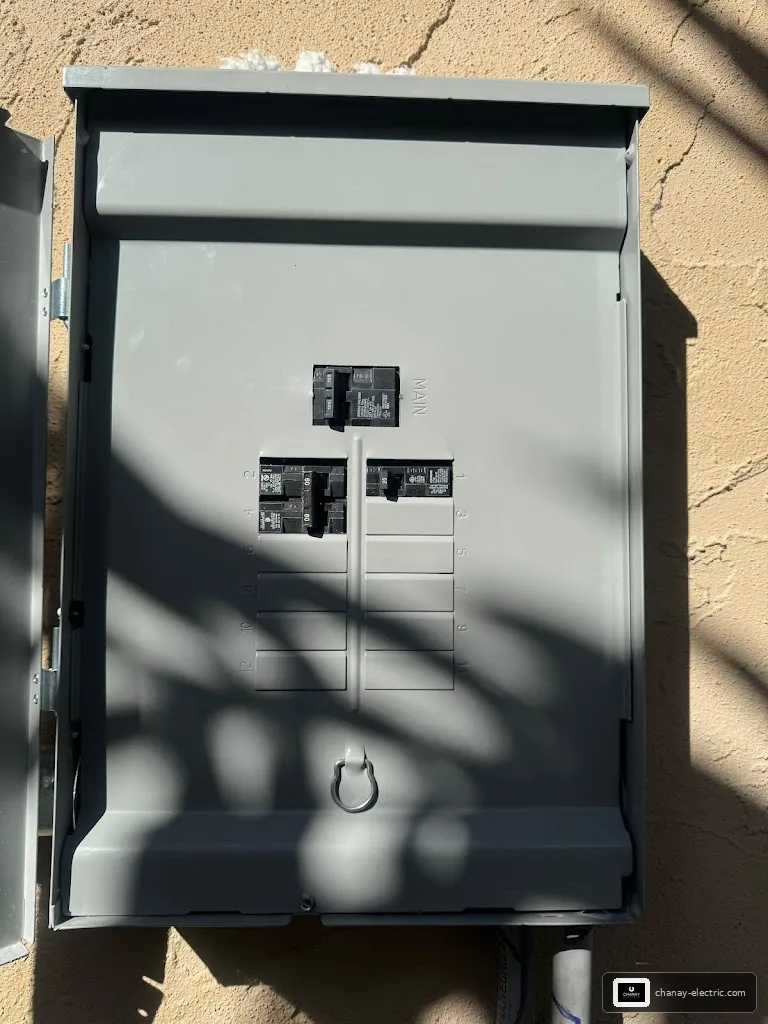
- Panel and switchgear servicing. Torque checks, cleaning, and visual inspection of breakers, bus bars, and disconnects.
- Emergency response terms. Guaranteed response windows, after-hours availability, and priority scheduling for contract holders.
- Documentation and reporting. Written findings after every visit, with photos, readings, and recommended follow-up work.
- Clear exclusions. What is not covered, such as full equipment replacement or damage from unrelated causes, should be stated plainly.
- Generator and backup power testing. Load-bank testing and transfer switch checks for facilities with standby power.
Federal and municipal procurement documents offer a useful benchmark here. A recent federal electrical maintenance solicitation and a county-level request for electrical services bid both specify detailed scopes covering inspection cycles, documentation requirements, and response times, the same structure a quality commercial agreement should follow regardless of whether the building is public or private.
How Do Licensing, Safety, and Code Compliance Fit In?
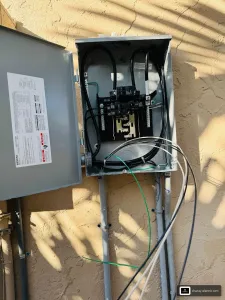
Licensing is not a formality, it is the baseline that determines whether an agreement is worth the paper it is written on. A licensed commercial electrical contractor carries the training, insurance, and accountability to work on live systems, interpret code requirements correctly, and stand behind the work performed.
The national standard most directly relevant to maintenance programs is NFPA 70B, the Standard for Electrical Equipment Maintenance. As of 2025, NFPA 70B transitioned from a recommended practice to an enforceable standard, a shift explained in detail by industry analysis of the NFPA 70B standard change. That means risk-based maintenance programs, documented inspection intervals, and condition-based assessments are no longer optional best practices for many facilities, they are becoming the expected baseline for insurance, liability, and code enforcement purposes.
For building owners who have already dealt with code issues during an inspection, the parallels are direct. Our guide on electrical code violations found during inspections covers how small deferred issues compound into larger compliance problems, a pattern that applies equally to commercial panels and switchgear left unmonitored for years.
What Does the Maintenance Process Actually Look Like?
A properly run commercial electrical maintenance program follows a consistent cycle rather than a one-time visit. Understanding that cycle helps set realistic expectations for what a service agreement actually delivers.
- Initial assessment. A full survey of panels, switchgear, wiring condition, and load history establishes a baseline.
- Risk-based scheduling. Equipment critical to operations, like main switchgear or generators, gets more frequent attention than low-risk circuits.
- Scheduled visits. Technicians perform thermal scans, torque checks, cleaning, and testing according to the agreed calendar.
- Documentation. Every visit generates a written report with readings, photos, and flagged concerns, creating a paper trail for insurers and inspectors.
- Follow-up and repair. Issues identified during routine visits are scheduled for correction before they become emergencies.
- Annual review. The agreement itself is revisited yearly to adjust scope as equipment ages or the building’s electrical load changes.
Modern programs increasingly fold predictive analytics into this cycle. Industry estimates suggest roughly 52% of commercial facilities now use some form of predictive maintenance, with sensors tracking temperature, vibration, runtime, and energy draw. According to smart building maintenance trend data for 2026, predictive systems can flag degradation two to four weeks before a likely failure and are associated with a 45% to 65% reduction in emergency repair calls among participating facilities. Buildings using AI-supported monitoring have reported up to 52% fewer unplanned outages and 44% lower electrical maintenance spending in their first year, though these figures are vendor-reported and should be verified against comparable facilities before being treated as guaranteed outcomes.
How Much Does a Commercial Electrical Maintenance Agreement Cost?
Pricing for a commercial electrical maintenance service agreement varies widely, and that is by design, not by accident. Scope, equipment criticality, visit frequency, building size, and the inclusion of generators or switchgear all shift the final number.
| Facility Type or Scope | Indicative Annual Range |
|---|---|
| Small commercial building, basic inspection | $1,500 to $5,000 |
| Larger facility with switchgear and generators | $5,000 to $15,000+ |
| Basic service plan style agreement | Roughly $199 to $549+ |
| Quarterly program with priority response | Often $549+ for smaller plans |
| Generator add-on coverage | Approximately $249 to $329 |
These figures are starting points, not quotes. Actual pricing depends on your building’s age, panel condition, square footage, and operational criticality, which is why we recommend a walkthrough before committing to a scope. If your facility’s electrical infrastructure dates back several decades, it may be worth reviewing our breakdown of electrical rewiring considerations for older properties before locking in a maintenance scope, since aging wiring often changes what a reasonable inspection interval looks like.
What Does a Good Contractor Do Differently?
Plenty of contractors will offer to “check your panels once a year.” Far fewer build a program that actually prevents the failures that cause downtime. The difference tends to show up in a handful of specific habits.
Photo and thermal evidence: attached, not verbal
Low-risk circuits: on a longer cycle
Insurance and liability coverage: verifiable
Trade groups and procurement guidance reinforce this same pattern. A detailed overview of NFPA 70B maintenance program chapters prepared for contractors, a contractor’s guide to NFPA 70B program requirements, emphasizes that documented condition assessments, not just calendar-based visits, are what separate a defensible maintenance program from a checkbox exercise. A good contractor treats that guidance as the floor, not the ceiling.
It also helps to work with a provider who understands your building’s full electrical history, not just what is visible during a single visit. If you’ve had panel work, circuit breaker replacement, or code remediation done previously, those records matter. Our team has documented processes like the one outlined in circuit breaker replacement in West Palm Beach, and that kind of project history should inform how a maintenance plan is scoped going forward.
Key Takeaways
- A commercial electrical maintenance service agreement schedules inspections, preventive work, and emergency response rather than waiting for a failure.
- Electrical faults contribute to roughly 30% of commercial-building shutdowns, with downtime costing $5,000 to $50,000 per hour.
- NFPA 70B’s shift to an enforceable standard means documented, risk-based maintenance is increasingly expected, not optional.
- Predictive maintenance adoption has reached an estimated 52% of commercial facilities, with early degradation flagged two to four weeks before failure.
- Pricing ranges widely, from roughly $1,500 for small buildings to $15,000 or more for facilities with switchgear and generators.
- Strong agreements include clear documentation, defined exclusions, and guaranteed emergency response windows.
- Choosing a licensed, insured contractor with a documented process protects both your equipment and your liability exposure.
People Also Ask
What is included in a commercial electrical maintenance contract?
Most contracts include scheduled inspections, thermal imaging, panel and switchgear servicing, documentation after each visit, and defined emergency response terms. Generator testing and specific equipment exclusions are typically spelled out separately.
How often should commercial electrical systems be inspected?
Most commercial programs schedule one to four visits annually, with frequency driven by equipment criticality and building age. Facilities with switchgear, generators, or heavy industrial load often need quarterly checks rather than annual ones.
Is preventive electrical maintenance required by code?
NFPA 70B is now an enforceable standard rather than a voluntary recommendation, which pushes many facilities toward documented, risk-based maintenance programs to satisfy insurance and liability requirements. Local jurisdictions and insurers increasingly expect this documentation as a baseline.
What is the cost of unplanned electrical downtime?
Industry estimates place unplanned commercial electrical downtime at $5,000 to $50,000 per hour, depending on occupancy type, business model, and which systems are affected. This is the primary financial argument for scheduled preventive maintenance over reactive repair.
Frequently Asked Questions
Do I need a service agreement if my building is relatively new?+
Yes, newer construction still benefits from scheduled monitoring, since thermal imaging and load checks can catch installation issues or connection loosening before they cause downtime. Waiting until problems appear often means paying emergency rates for something a routine visit would have caught early.
What happens if my contractor finds a problem during a scheduled visit?+
A good agreement specifies that findings are documented with photos and readings, then presented with a recommended repair timeline and cost estimate before any additional work begins. You should never be surprised by unauthorized work under a well-written contract.
Can a service agreement be customized for my building type?+
Yes, agreements should reflect the specific equipment, occupancy type, and risk profile of your facility rather than following a generic template. A restaurant, medical office, and warehouse each have different critical systems that warrant different inspection priorities.
Does a maintenance agreement cover emergency repairs?+
Most agreements define emergency response terms, such as guaranteed response windows and priority scheduling, but full emergency repair costs are often billed separately unless specifically included. Review the exclusions section closely before assuming coverage.
How do I verify a contractor is properly licensed for commercial work?+
Ask for proof of state electrical licensing, liability insurance, and references from similar commercial properties before signing an agreement. A reputable contractor will provide this documentation without hesitation.
What is the difference between preventive and predictive maintenance?+
Preventive maintenance follows a fixed schedule regardless of equipment condition, while predictive maintenance uses sensors and data to flag degradation before it becomes a failure. Roughly 52% of commercial facilities now use some form of predictive monitoring alongside traditional scheduled visits.
A commercial electrical maintenance service agreement is not just another line item, it is the foundation that keeps everything else you’ve invested in your building’s electrical system working the way it should. Whether your facility needs a first-time assessment, a review of an existing maintenance scope, or help understanding how older wiring or panel upgrades factor into a long-term plan, our team at Chanay Electric is ready to walk your property and build a program around your actual risk, not a generic template. You can also review examples of our completed work across electrical projects throughout Broward County or learn more about our team on our about page. Contact us today to schedule a walkthrough and get a custom quote tailored to your building’s electrical systems.